Showing posts with label Fairbanks. Show all posts

Friday, June 24, 2011

Alaska Trip 2011: June 13 - Arctic Adventure Last Day

This is page 25 of our Alaska 2011 trip journal. Click here for the first page. If you want to bookmark this journal, http://jeanne-travels.blogspot.com always links to the newest page.

Today we start the long journey back to Fairbanks. We are going to try to make the entire 500 miles today. Maybe we'll get there before dark. Ummm.... I think that would be about August. It's been at least 2 or 3 weeks since we have seen darkness at night. Fairbanks is south of the Arctic Circle, so the sun does go down, but it doesn't get very dark. There's just a little twilight for the hour or two that the sun dips below the horizon.

Strange Gas Station
Of course we have to fuel up before hitting the road. We located the gas station on the map, and then drove right by it, because it didn't look like a gas station. The pumps are inside a small metal shack, with tanks behind to hold the fuel. I'm guessing the above-ground tanks are to protect them from frost heave, and the little shack is to keep the pumps from freezing or getting covered by snow. You can watch the meter through the window.


On the Road Again
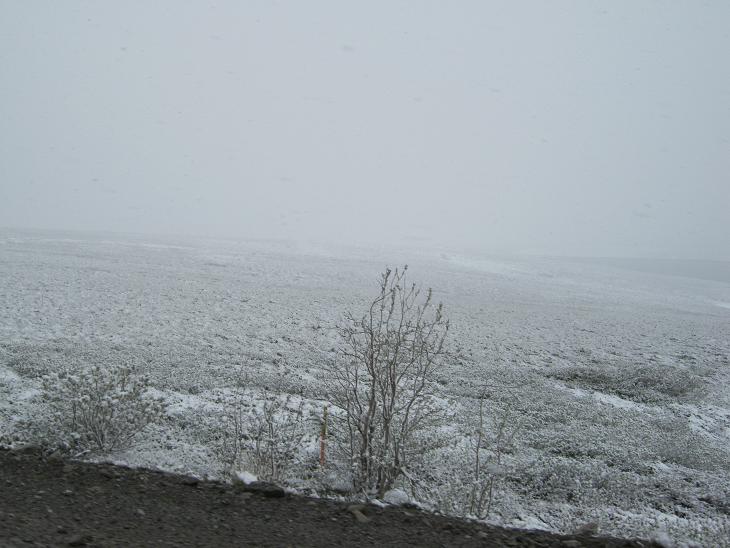
It's about 32° and overcast as we head south, and the clouds ahead look like snow. The area gets only about 4 inches of rain a year, most of it in the form of snow. Compare that to the Sahara Desert, which averages over 7 inches in a year. Yet the area is basically a flat wetland, with standing water everywhere. The permafrost is very close to the surface here, so when the snow melts there is basically no place for it to go.

I have two pictures of the tundra to share. One shows the frost heaves in the ground, and the other just the expanse of wetland.


Caribou Crossing
We had to wait for a herd of caribou to cross the road, and then saw more grazing just down the road.


Road Conditions
Here are two more pictures illustrating the road conditions. The first is on one of the rare sections of paved road. notice the crack across the road? Follow it down the side to see how deep it is. The other picture is after we ran into the snow. It shows what happens to the unpaved sections of road when they get wet. Needless to say, we are now collecting even deeper layers of mud.


Snowing Harder

At this point, it has started to snow harder. The mountains are still in the distance, but you can already tell there is more snow on them than there was when we came by here yesterday. The temperature is dropping, down to 30° so far, and the snow is starting to stick a little more.

Ghost Mountains

This was such a strange effect to me. The snow and fog made the mountains look shadowy, like an eerie ghost.


Atigun Pass Revisited

Atigun Pass looks a lot different than it did yesterday. It was a bit colder, too - the temperature dropped to 28° as we came across. There was no ice or snow on the road when we were here, just the mud. Later on, we did hear one trucker talk about having to chain up to cross the pass in the morning.


South of the Pass
Once we got through the pass, the weather changed just as abruptly as it did going the other way. The temperature started rising, and the snow changed to rain, and eventually cleared up. After that, it stayed dry most of the way back, until we ran into a light shower near Fairbanks


More Mud
When the snow changed to light rain, it was still making lots of fresh mud, but the rain loosened it a little at the top, causing it to run rivers of mud down the side. Yuck. And the picture does not even show how deep it is on the running boards and back bumper.

More Wildlife

We got a pretty good look at this moose. You can even see the velvet on his freshly sprouted antlers. You might have to zoom in the picture to get a better look.


We saw two different foxes, within about half an hour of each other. Believe it or not, these are red foxes. This surprised me, since they are not the normal red color, but when I looked them up to see what they were, I learned that red foxes come in about four color variations. This one is called a cross fox, because the shading on the back and shoulder resembles a cross. You can see it best in the second picture. The second fox, in the lower two pictures, was carrying some kind of prey. We did not get a good look at what it was.


Alpenglow and Rainbows
As we got back near Fairbanks, we were treated to two different visual effects - alpenglow and a rainbow. Alpenglow is what is making the green trees glow red. Has something to do with the sun being below the top of the hill, and the rays refracting or bending over the top. The sun has not really gone down yet, but depending on which direction we are pointing on this winding road, it may or may not be behind a mountain.


By the way, these pictures were taken a little after midnight, by the light of the midnight sun. We did make it back to Fairbanks before sunset, which was around 12:30.

Back in Fairbanks
Our Arctic adventure was an amazing journey - I'm really glad we decided to go ahead with it. There are so many things in this world that you think you understand, but until you experience it, you really don't understand. We could have spent more money and flown to Deadhorse, but it would not have been the same experience.


Thursday, June 16, 2011

Alaska Trip 2011: June 6-10 - Fairbanks

This is page 22 of our Alaska 2011 trip journal. Click here for the first page. If you want to bookmark this journal, http://jeanne-travels.blogspot.com always links to the newest page.

We spent several days in Fairbanks. We did many of the tourist attractions, and worked in a bit of rest and relaxation as well. We camped at North Pole, which is just outside of town.

Fairbanks is essentially another tourist town, but not to the extent of some other towns. We did not see the crowds and the row after row of jewelry stores that you see in places like Skagway. Fairbanks is also the farthest north town of any size in Alaska, though it is still about 200 miles south of the Arctic Circle. It was also a good place to re-stock our supplies, as it was the first place we have seen with major stores in over a month.

It's amusing to see what they call an expressway here. Basically it's a major throughfare that might or might not have four lanes instead of two. They did have one road that actually had an on ramp.

Santa Claus House
The biggest (only?) attraction in North Pole is the Santa Clause House. It's basically a tourist stop, but nicely done. They had very yummy fudge also.


Of course, Santa Claus has reindeer. Reindeer and Caribou are very similar, with the main difference being that the reindeer is a domesticated species. These reindeer are snoozing in the shade.


Besides reindeer, apparently Santa also has a moose...

I loved the murals on the outside of the building, done in ceramic tile.


Large Animal Research Center
LARS is a research center affiliated with the University of Alaska, primarily focused on Musk Ox and Caribou. They give regular tours to see some of the animals they study here. These animals are pretty much acclimated to humans, so it was a bit like visiting a zoo.

The first picture is one of the musk ox bulls. Most of the time, they keep them separate from the cows and calves.

Looking at these pictures of musk ox cows and babies, one question comes to mind... How could such an ugly mama have such cute babies?


This weird display was to illustrate the difference in size between the bulls and the cows. The bulls are about twice the size.


There weren't too many caribou within sight of the tour, but we did see a few. Although tame, these are actually caribou, not reindeer. The biggest difference between the species is that the reindeer are domesticated, but there are other minor differences as well.


The coming of warm weather has the animals losing their winter coats. This makes them look pretty scruffy.


There was a mama and baby caribou hiding in the corner, a little difficult to see.

Riverboat Discovery
We took a cruise trip on the Riverboat Discovery down the Chena River. This narrated tour was well-orchestrated, and illustrated some selected aspects of the Alaskan lifestyle and history.


Shortly after launch, we were greeted by a bush plane who just happened to be landing on the river nearby. Then he took off again, saying he needed to be some place in the mountains later in the afternoon.


Of course the touch-and-go was orchestrated for the tour, but it was to illustrate that a lot of Alaskans have their own planes and fly. The distances involved and the lack of roads in many places make it almost a necessity for some people. Here is a house where they basically park their plane in the driveway.

Our next stop was at a sled dog kennel. Sled dogs are still a necessity for travel in some places in the winter time, but dog mushing is also a major sporting event, with many dogs being raised just for the sport. The people at the kennel showed some of the ways they train the dogs and keep them in shape.

You always hear people say how the dogs love to run, and love to pull. While I never doubted that they enjoy it, I did not realize HOW MUCH they love it. You should have seen these dogs as they were getting hitched up to an old tractor they use for summertime practice. They were SO excited and eager to go. When it was time, they took off at a full run.


There was a variety of houses along the river, with a variety of "stuff" around them. One homeowner had some old riverboats, including this one.

The tour went to the confluence of the Chena and Tanana Rivers before turning around and going back. The first picture shows the clearer waters of the Chena flowing into the milky Tanana. The second picture doesn't show the confluence as well, but I still thought it was pretty.


Eldorado Gold Mine
This tour started out by taking you through an old gold mine, explained how the mining was done, and demonstrated panning for gold.


After the demonstration, they handed everyone a little bag of dirt, and let you try your luck at panning the gold out of it. You get to keep whatever you find, and everyone is guaranteed to find something, or they give you another bag to work. They told us our "take" was worth about $50 between the two of us, but then we spent more than that on a locket to put it in. So they get you one way or another. I figure they are probably seeding the bags so everyone gets something, but still, it was fun.


The Alaska Pipeline
On the way back from the gold mine, we stopped at a pullout that ran right up next to the pipeline. The small information center here was closed at the time, but you could still read the storyboards and get an up-close and personal look at the actual pipeline.

Pigs are used inside the pipes to clean gunk off the inner walls, or to run telemetry to check the condition of the pipes. The displays here included two examples.